Old Woman of the Nameless Isle
The Old Woman of the Nameless Isle is one of two castaways who have lived for perhaps forty or fifty years on a barren sandbar in the East Reach, a place so remote and desolate that they had forgotten there were other people in the world. Her encounter with Ged, shipwrecked and half-drowned on their shore, reveals a life reduced to the barest survival and a desperate, wordless clinging to a lost royal identity, making her a figure of profound desolation and silent yearning.
Identity and Background
The Old Woman and her companion, an old man, are Kargish, as Ged learns when the only word he knows of their language—"Kargad"—prompts a single, puppet-like nod from the man. They live in a small, rickety hut built of driftwood planks and branches, nestled in a hollow of the dunes. Their water comes from a little brackish well, their food from fish, shellfish, and rockweed. The tattered hides in the hut and a small store of bone needles, fishhooks, and sinew for fishlines and firedrill come not from goats but from spotted seal, for this is the kind of place where seals raise their pups in summer. The old woman's most treasured possession, which she keeps wrapped in a rag, is a little child's dress of silk brocade stiff with seed-pearls, stained with salt and yellow with years. On the small bodice, the pearls are worked into the shape of the double arrow of the God-Brothers of the Kargad Empire, surmounted by a king's crown. From a hiding place sewn in the skirt of the dress, she takes a small object: a bit of dark metal, the half-circle of a broken ring. Ged guesses that these two might be children of some royal house of the Kargad Empire, sent by a tyrant or usurper to be cast away on an uncharted islet far from Karego-At. One had been a boy of eight or ten, the other a stout baby princess in a dress of silk and pearls; they had lived, and lived on alone, prince and princess of Desolation.
Life on the Isle and Encounter with Ged
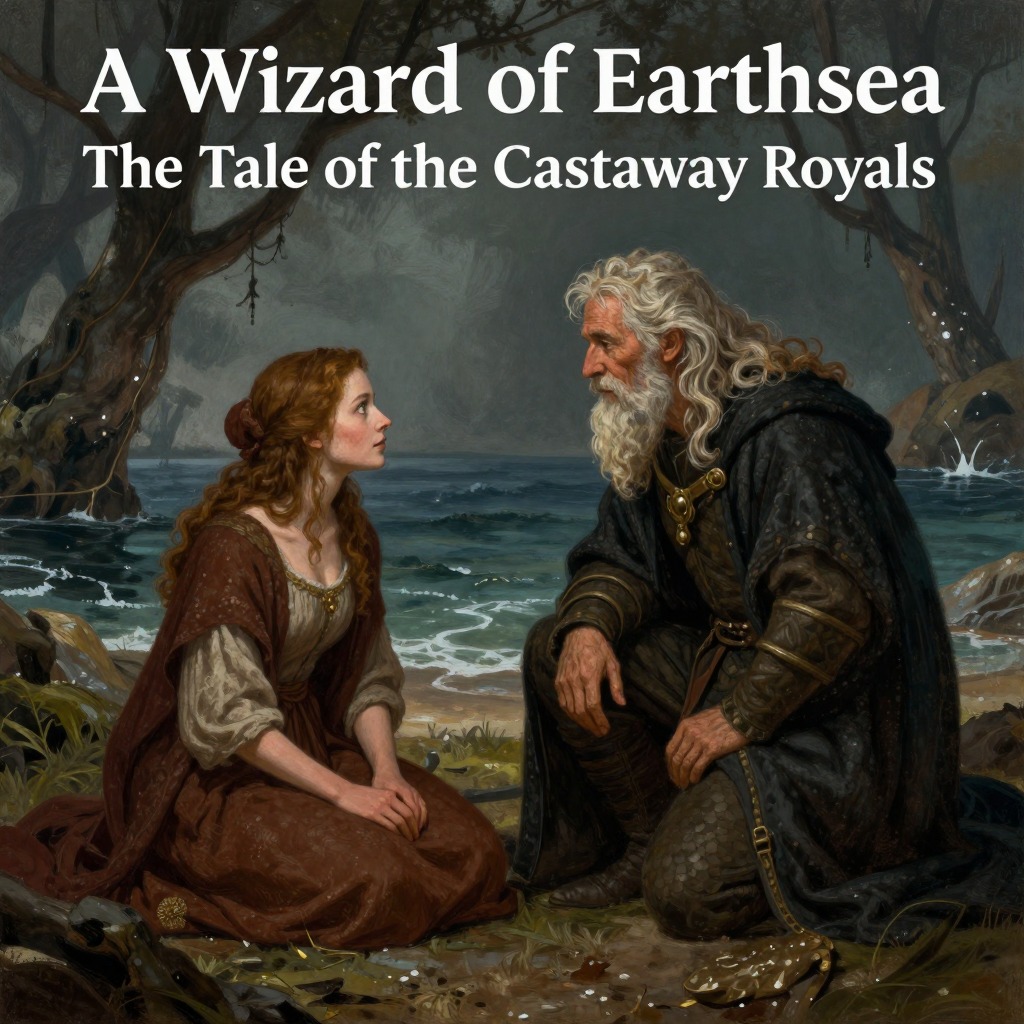
When Ged first enters their hut, the old woman is peering from a heap of rags or hides on the floor. Both she and the old man are blank with terror. When Ged lays down his staff, she hides under the pile of rags, whimpering. He strips naked and huddles over the firepit, asking for something to wrap himself in, but neither answers. He reaches out and takes a rag from the bed-heap—a goat-hide, now all tatters and black grease—and the old woman moans with fear. The old man, in a stupor of fear, does not move when Ged asks for wood to build up the fire. Ged builds the fire himself and, with gestures, asks for water. Cringing, the old man points to a great shell that holds water and pushes towards the fire another shell with strips of smoke-dried fish. The old woman's sullen dread never lessens; when Ged thinks he is coming close enough to touch him, the old man hobbles away, peering back with a scowl. At first, the old woman whimpered and hid under her rag-pile whenever Ged moved, but as he lay dozing feverishly in the dark hut, he saw her squatting to stare at him with a strange, dull, yearning look. After a while, she brought him water to drink. When he sat up to take the shell from her, she was scared and dropped it, spilling all the water, and then she wept, wiping her eyes with her long, whitish-grey hair. Later, she watches him as he works down on the beach, shaping driftwood and planks from his wrecked boat into a new one, using the old man's crude stone adze and a binding-spell. She does not watch his marvelous work so much as she watches him, with that same craving look in her eyes. She goes off and comes back with a gift: a handful of mussels she has gathered on the rocks. Ged eats them as she gives them to him, sea-wet and raw, and thanks her. Seeming to gain courage, she goes to the hut and returns with the bundle wrapped in a rag, unwrapping it to show him the little child's dress. She points at the dress and at herself, and smiles: a sweet, unmeaning smile, like a baby's. She then takes the broken ring from the skirt and holds it out to Ged, gesturing that he take it, and is not satisfied until he does; she has made him a present. The dress she wraps up carefully in its greasy rag-coverings and shuffles back to the hut to hide it away.
Refusal to Leave and Ged's Gift
Ged tries to tell the old ones that he will take them to any land—Gont, Spevy, or the Torikles—or even leave them on some lonely shore of Karego-At, though Kargish waters are no safe place for an Archipelagan to venture. But they will not leave their barren isle. The old woman seems not to understand what he means with his gestures and quiet words; the old man does understand, and refuses. All his memory of other lands and other men is a child's nightmare of blood and giants and screaming, a fear Ged can see in his face as he shakes his head. So Ged, unable to thank them for their fire and food and having no present for the old woman as he would have liked, does what he can: he sets a charm on that salty, unreliable spring. The water rises up through the sand as sweet and clear as any mountain spring in the heights of Gont, and it never fails. Because of it, that place of dunes and rocks is charted now and bears a name; sailors call it Springwater Isle. The hut is gone, and the storms of many winters have left no sign of the two who lived out their lives there and died alone.
Narrative Role and Significance
The Old Woman of the Nameless Isle serves as a poignant emblem of the human cost of political cruelty and the resilience of life in the most extreme isolation. Her silent, yearning gaze and her gift of the broken ring—a fragment of a lost royal lineage—provide Ged with a tangible link to the Kargish world he has only ever known as an enemy. The ring, which he keeps with care, becomes a seed for his later quest to the Tombs of Atuan, where he will seek the Ring of Erreth-Akbe. Her story, a tale of a princess cast away to die, underscores the themes of exile and the search for identity that run through Ged's own journey, while her unmeaning smile and the sweet, clear spring he leaves behind offer a quiet counterpoint to the novel's darker currents of shadow and pursuit.